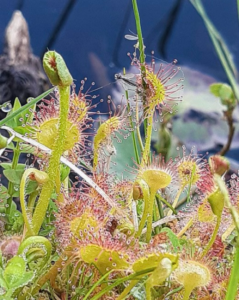

Article by Will Husby and Sheree Johnson | Photo by Nova Pon, “Sundew on the Lake”
Sundew on the Lake — Nova Pon
Nova Pon’s photo captures something easy to miss: a round-leaved sundew, glittering in the sun. It looks delicate — just a small rosette of red-tipped leaves beaded with what seems like dew. But it is tough, adapted to living in a harsh environment.
The round-leaved sundew is one of Bowen Island’s two carnivorous plants. They grow only in bogs, a type of wetland, alongside sphagnum moss, pitcher plants (Bowen’s other carnivorous plant), Labrador tea, bog laurel, and bog orchids. Unlike the giant flesh-eating plants of horror movies, the sundew is small, growing in a rosette only a few centimetres across and no taller than a hand is long. Each leaf has a slender stem that ends in a round blade about as wide as your thumbnail. Across the leaf’s upper surface are short red hairs, each tipped with a tiny sugary drop of sticky fluid that sparkles in sunlight. A sweet smell entices insects to land for a tasty snack, only to discover themselves ensnared in a sticky death trap.
Catching a Meal
Bogs are difficult places for plants to live. Their soils are low in the nutrients that plants need to grow. While other bog plants struggle to gather enough through their roots, the sundew gets what it needs by catching and digesting tiny midges, beetles, ants, and mosquitoes. At the top of Nova’s photo, you can see this sundew has already caught two small midges.
Once an insect is trapped, the leaf slowly folds around it and releases digestive juices that turn the soft parts into liquid. The leaf absorbs those nutrients and uses them for growth. You can see one of these folded leaves in the top left corner of Nova’s photo. When only the insect’s hard exoskeleton remains, the leaf slowly opens again, ready for another catch. Halfway down the right-hand side of the photo, the dark grey blobs on one leaf are probably the remains of a fully digested insect.
Sundews do more than feed themselves. Some of the nutrients they collect from prey are later released into the soil, where nearby bog plants can use them. Even in a small wetland, they are part of a larger living system.
Flowers Without Fanfare
Their insect-catching habit is only one of their remarkable adaptations. Sundews also save energy by not producing nectar to attract pollinators. Their tiny white flowers—no bigger than a peppercorn—appear each summer in groups of two to fifteen. Each flower opens for only a couple of hours on a single day, and only in direct sunlight, giving pollinators a very short window to find them. Most of the time, the flowers pollinate themselves.
They are equally inventive when it comes to seed dispersal. Bowen’s wetlands are small and often separated by forest or cleared land, so getting seeds to the right place is no small feat. Each plant produces hundreds of slender, light-brown seeds that can travel on the wind for up to 10 kilometres. The seeds are also waterproof and can float for months along streams, lakes, and ponds, and some may even hitch a ride in the feathers of waterbirds.
Beyond all this, round-leaved sundews are simply beautiful. Their crimson hairs and sparkling droplets create a flash of colour against the soft green of the bog. What looks small and easily overlooked is, in fact, one of Bowen’s most fascinating plants.
Protecting Bowen’s Bogs
Clearing and draining bogs and other wetlands on Bowen has reduced round-leaved sundew habitat by changing the conditions these plants need to survive. The wetlands that remain still depend on the conditions that sustain plants like this. By keeping these places intact and treading lightly when we visit them, we help sundews and the other specialized plants of their bog community endure.
The next time you are near a Bowen wetland, slow down and look closely. You may spot a sundew at work.
The Bowen Island Conservancy is a land trust and registered charity that works to protect and preserve the island’s natural environment—from endangered coastal bluffs to inland lakes, wetlands, and fens. This article is part of a monthly series featuring photographs submitted to the Bowen Island Conservancy’s Biodiversity Photo Contest. To see the latest submissions and winners, visit the Conservancy website.
